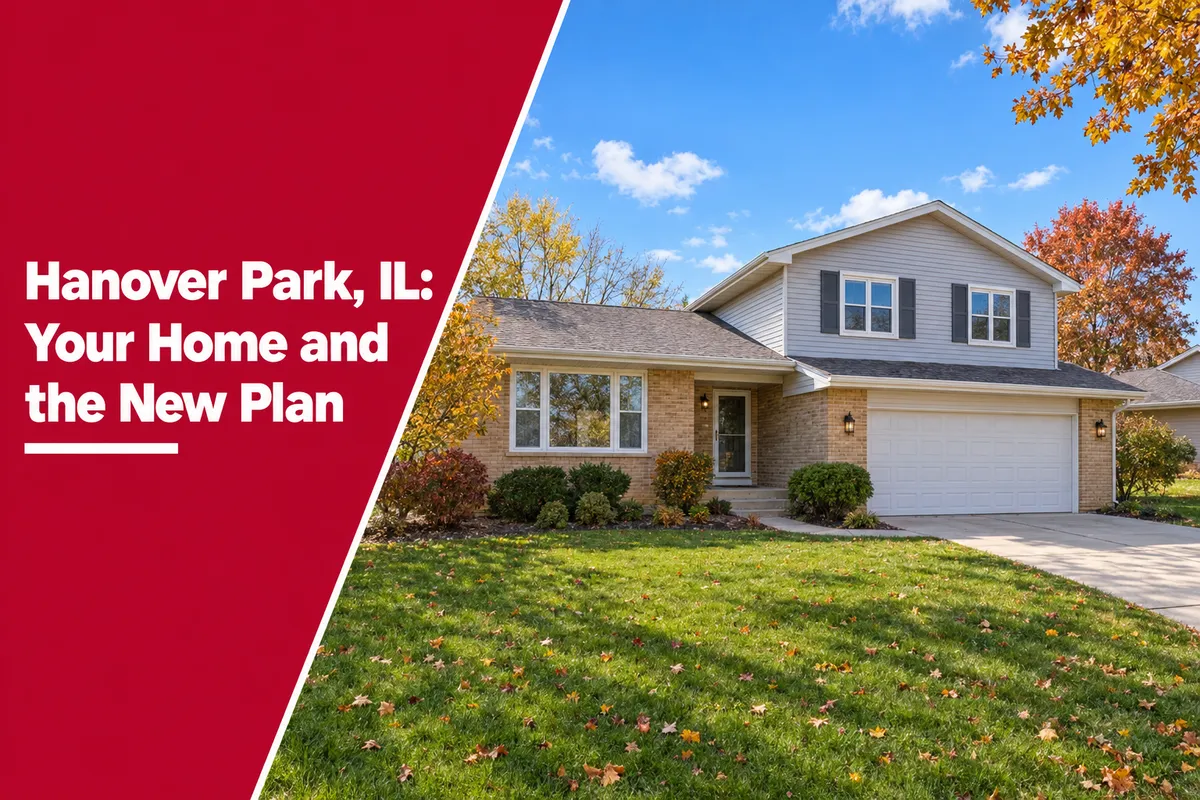
Does Hanover Park, IL's New Comprehensive Plan Affect Your Home?
The Hanover Park comprehensive plan won't rezone your lot or change your tax bill the day it's adopted, but it will guide what the village approves around you for years, especially near Lake Street and the Metra station. If you own or are buying in Hanover Park, look up your block on the draft plan's land-use map before the Development Commission's public hearing on Thursday, November 12, at 7 p.m., and use the open house from 5 to 6:30 p.m. that evening to ask questions in person.
Whenever a village posts a notice with the words "comprehensive plan" in it, the call I get sounds about the same: "Is something going up behind my house, and should I sell before it does?" Usually it's no on both. But a plan meant to guide the village for the next 25 years is worth an hour of your time, and very few homeowners give it that hour until a bulldozer shows up.
What is the Hanover Park comprehensive plan, and why is it being rewritten now?
A comprehensive plan is a village's long-range blueprint for land use and community facilities. Hanover Park's current plan was adopted in 1998 and updated in 2010, according to the village's comprehensive plan page, which says it gives officials policies to carry out "through regulations and the development approval process." In other words, the plan doesn't build anything. It tells the people who approve projects what the village wants.
The rewrite has been in the works for a while. The project website calls the new plan a community vision to guide Hanover Park for the next 25 years, built from existing conditions, goals and an action plan, and says the Village Board and Development Commission will approve and adopt it. Minutes from January, included in the Development Commission's March 12, 2026 packet, noted that staff had a draft in hand and was working on the financial analysis.
Now the draft is out for public review. The plan's documents page lists the Draft Comprehensive Plan along with a Vision, Goals and Key Recommendations memo and an Existing Conditions memo, and the village homepage is promoting a community open house on November 12 from 5 to 6:30 p.m., followed by the public hearing at 7 p.m.
What a comprehensive plan can and can't change for your Hanover Park home.
Most of the worry starts here. The plan is a guide. Zoning is the rule. Your lot's zoning district decides what can legally be built on it today, and that doesn't change unless the village goes through a separate zoning process with its own notices and hearings.
What the plan does change is direction. When a developer asks for a rezoning or a special approval, one of the first questions village staff and the Development Commission ask is whether the request lines up with the comprehensive plan. A parcel the plan marks for townhomes or mixed use is an easier yes for that kind of project. A parcel the plan keeps as single-family is a harder sell for anything denser.
Here's how I'd sort it if you own a house in town:
- Your own home. The plan doesn't take away your right to live in it, sell it or remodel it within current zoning.
- Your tax bill. A plan doesn't set a levy. Your bill still comes from your assessment and the taxing districts' budgets.
- The vacant lot, aging strip center or big parking lot near you. This is where the plan matters most. Look at what the map calls for there.
Where Hanover Park is already planning for change: the Village Center around the Metra station.
You don't have to guess where the village wants growth, because it has said so for more than a decade. In May 2012, the Village Board adopted a transit-oriented development plan for the Metra station area as an amendment to the comprehensive plan, aiming to turn the station area into a true Village Center with more housing, mixed-use retail and offices, according to the RTA's project record. The same record notes a 126-unit townhome development finished in 2014 about a quarter mile north of the station.
In 2022 the village took the next step and proposed new Village Center zoning districts around the station: a mixed-use core next to the station and along the main streets, a mixed residential district beside it, a neighborhood district made up mainly of attached and detached single-family homes, and a public and institutional district, per the village's public hearing notice. The area is framed by streets including County Farm Road, Ontarioville Road, Devon Avenue, Lake Street and Church Road. Those districts are now part of the village code; this spring the Development Commission was still fine-tuning their façade material rules, per its May 14, 2026 agenda.
The south commuter lot shows how slowly these things can move. In July 2025, trustees gave conceptual approval to a 199-unit apartment plan on the lot at County Farm and Ontarioville roads, the Daily Herald reported. By January 2026, the Development Commission minutes noted that the developer had backed out and staff would look for others. So the land is still a parking lot, still in the plan for redevelopment, and still without a builder.
For homeowners near the station, that's the real lesson. The direction has been set for years. The timing is anyone's guess.
How to read the draft Hanover Park comprehensive plan before November 12.
Skip the cover-to-cover read. Give it 30 minutes and focus on what touches your address:
- Find your block on the future land-use map. Note the category for your street and for every nearby parcel that isn't a house: lots, shopping centers, churches, office buildings.
- Read the key recommendations memo. It's the quick way to see what the village considers a priority.
- Look for corridor and subarea sections. If you live near Lake Street, Irving Park Road, Barrington Road or the station, those sections speak to you more directly than anything else in the document.
- Write your questions down. The open house is the place to ask staff what a map color actually means. The public hearing is the place to go on the record.
- Know your county. Hanover Park sits in both Cook and DuPage counties and spans four townships, per its public village record. That doesn't change the plan, but it changes your taxes, appeal process and closing math.
Then go. A comment made on the record before adoption carries further than a complaint made after the first project application arrives.
What the comprehensive plan means for Hanover Park homeowners, buyers and sellers.
Owners planning to stay should treat the plan as the best preview of the next decade on their side of town. If something is marked for change nearby, you'd rather learn it at an open house than from a yard sign. If you're in the Cook County part of town and your bill jumped this fall, also read whether you can still appeal your property taxes in the Schaumburg area, since part of Hanover Park falls in Schaumburg Township, while the DuPage side runs on its own county process.
Buyers have a simple homework item: ask your real estate agent to pull the plan's map for any address you're serious about, the same way you'd check the inspection report. A quiet street next to a parcel marked for mixed use isn't a deal-breaker. It's something you should know before you pick the price you're willing to pay. If you're still deciding whether the town fits you at all, here's a broader guide for buyers choosing a home in Hanover Park.
Sellers get the shortest rule of the three. A 25-year plan isn't in this winter's comps, and comps are what an appraiser reads, so set the price on what has closed. If you're near the station, market what exists today, like the train and the commute, and describe anything planned as planned. I made the same point to Roselle owners wondering whether to wait for their new library before selling: waiting for a future project rarely pays.
Ryan's take: If you own within a few blocks of Lake Street, Devon Avenue or the Metra station, bring your address to the November 12 open house and find your block on the land-use map yourself. Ten minutes with the map and a staff member beats every rumor on a neighborhood page.
The Hanover Park details that move your home's price more than any plan.
When I price a home here, the plan is background. Any seasoned real estate agent working this town will tell you the same: these are the things that show up in the number.
- Build era. Hanover Park went from 451 residents in 1960 to 11,735 in 1970 and 28,719 in 1980, per its public village record, so much of the housing stock went up in that stretch. Original roofs, windows, electrical panels and basements are what buyers and inspectors look at first.
- The train. The Hanover Park station at 1975 W. Lake St. sits on Metra's Milwaukee District West line, 28.4 miles from Chicago Union Station, per its public station record. For a commuter, a walk to that platform is worth real money.
- Which county you're in. Cook bills taxes a year behind on its own calendar, DuPage on another, so the tax credit at closing depends on which side of the line the house sits.
- The village transfer tax. A title company's transfer stamp list revised November 2024 puts the Hanover Park stamp at $3 for every $1,000 of price, a seller cost, and says the village reads the water meter for the final bill the day before closing. Confirm the current rate with the village before you count on it.
Before you weigh any of the plan's long-range ideas against selling, get a current number on the house itself. Send your address through my Hanover Park home value request, and I'll come back with a figure, then test it on a walkthrough of the house before we talk strategy.
How Hanover Park compares with the communities around it.
- Schaumburg: to the northeast, with bigger retail and office hubs and its own stop on the same Metra line in the village's southwest corner.
- Roselle: just east, another Milwaukee District West train town, with its own downtown and a new library under construction on Maple Avenue.
- Hoffman Estates: to the north, where the housing runs from the village's 1950s beginnings to much newer subdivisions out west.
- Bartlett: to the west, with its own Metra stop on the same line and a mix of older homes near its downtown and newer subdivisions farther out.
- Streamwood: to the northwest in Cook County, with plenty of ranches, split-levels and two-stories from the same decades as much of Hanover Park.
- Bloomingdale: to the southeast in DuPage County, a good comparison if you want to stay entirely on the DuPage tax calendar.
Frequently Asked Questions
1. When is the Hanover Park, IL comprehensive plan public hearing?
The village lists a community open house on Thursday, November 12, 2026, from 5 to 6:30 p.m., followed by the public hearing at 7 p.m.; check the village website for location details.
2. Does a comprehensive plan change my zoning?
No. A comprehensive plan guides future decisions, while zoning is the legal rule, and rezoning a property requires its own separate process and hearing.
3. What is the Village Center in Hanover Park, IL?
It's the area around the Hanover Park Metra station that the village has planned since 2012 as a denser center with more housing and mixed-use buildings, backed by its own zoning districts.
4. Is Hanover Park in Cook County or DuPage County?
Both. Check the county printed on your tax bill, because it changes your tax calendar, your appeal process and the tax credit at closing.
5. How far is the Hanover Park Metra station from downtown Chicago?
The station is 28.4 miles from Chicago Union Station on the Milwaukee District West line; Metra's current schedule has exact travel times.
Final Thoughts
A comprehensive plan is one of the few times a village asks residents what they want before anything is proposed. In Hanover Park, the direction around the station has been clear since 2012, and the new plan will shape what comes next across the rest of town. Read the map for your block, show up on November 12 if something near you is marked for change, and keep the plan in its proper place when you decide whether to buy or sell.
My office is a short drive away in Schaumburg, and Hanover Park is one of the six core towns on my map. I work as Ryan Saoudi, a solo Realtor® with eXp Realty. No teams. No hand-offs. Just me. If you want to know what your Hanover Park home would sell for today, or what a parcel on the plan's map could mean for a house you're about to buy, call Ryan Saoudi, Realtor®, at 773-389-4193 and we'll go through it together, map and comps on the table.