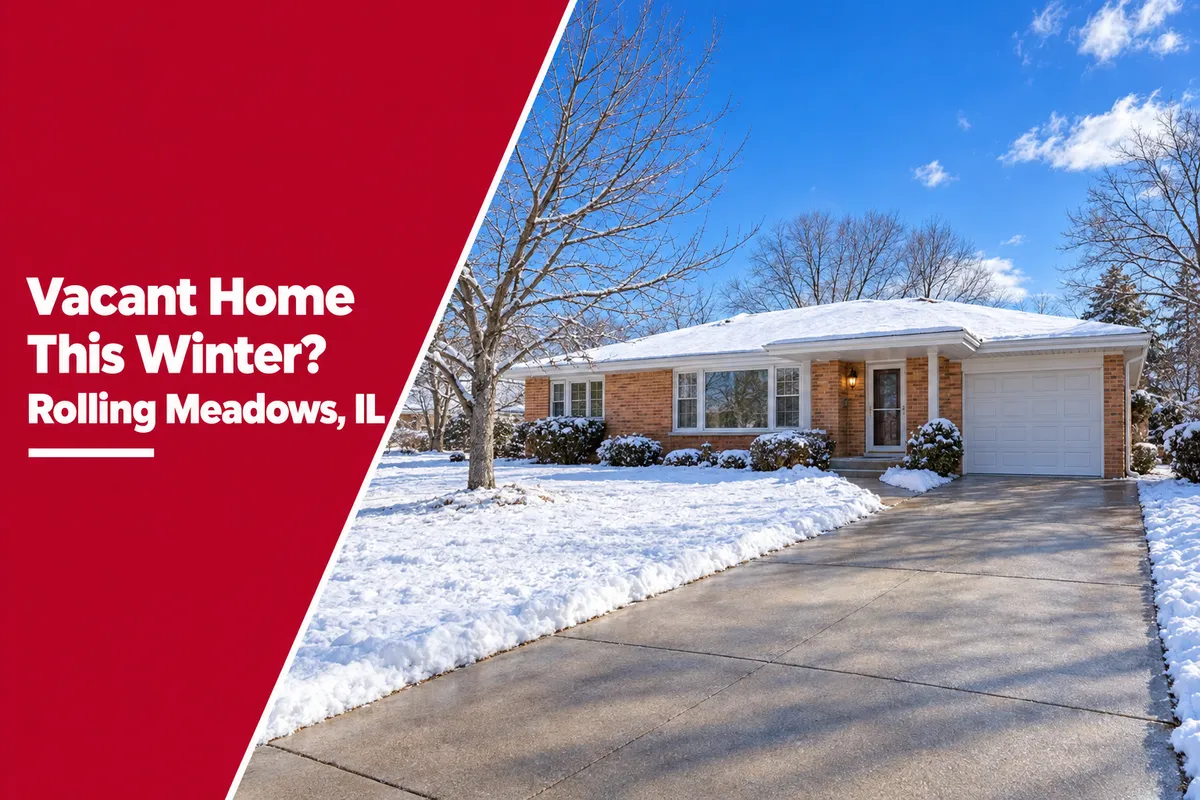
Selling a Vacant Home This Winter in Rolling Meadows, IL
Selling a vacant home this winter in Rolling Meadows is very doable, as long as three things are handled before the moving truck leaves: your insurance carrier knows the house is empty, the heat and water have a plan, and someone is inside the house on a schedule. Most of the expensive surprises with an empty listing in January come from skipping one of those three, not from the market.
The call I get from relocating sellers this time of year usually starts the same way: "We start the new job in December. The house won't be sold by then. What happens to it?" An empty house in an Illinois winter has no one to notice a furnace that quit or a walk nobody shoveled before a showing. Here is what I set up with sellers who leave before the sale, including a Rolling Meadows rule most owners have never heard of.
Why selling a vacant home this winter needs a plan before you move out.
An occupied house gets watched for free: someone hears the furnace, sees water on the floor and clears the driveway. Move out, and each of those jobs becomes somebody's assignment, or nobody's.
Winter raises the stakes. Rolling Meadows began as a Kimball Hill development, with first residents in 1953 and incorporation in 1955, per its public record. By 1955 about 700 homes had sold, so much of the original housing is now around 70 years old, often with decades of plumbing changes behind the walls. In older homes, the pipes on exterior walls, in crawl spaces and in garage runs are usually the first to freeze. That's not a reason to wait. It's a reason to plan the empty months like pricing and photos.
Call your insurance agent before the house is empty, not after something breaks.
This is the step sellers skip most, and it can cost the most. Many homeowners policies pull back coverage once a house has been vacant for a set stretch of time. Insurance writer Jack Hungelmann explains in IRMI's guide to managing the risks of a vacant home that after 60 days of vacancy a homeowners policy removes important coverages, including vandalism and glass breakage. Some carriers use a shorter window: a June 2026 coverage question in PropertyCasualty360's FC&S column involved a policy with a 30-day vacancy condition that required the owner to notify the carrier in writing, in advance.
The same column describes the freezing exclusion that matters most in a Chicago-area winter: freezing damage to plumbing is excluded unless the insured kept heat in the building. If the furnace dies and nobody notices, the burst-pipe claim can be in trouble.
Before you move out, ask your agent four questions and get the answers in writing:
- How many days can the house be vacant or unoccupied before any coverage changes?
- What does the policy require me to do about heat and water while it's empty?
- Do I need a vacancy endorsement or a separate vacant-dwelling policy, and what does it cost?
- Does leaving some furniture in place change whether the house counts as vacant?
On that last one, Hungelmann notes that courts have generally treated a home as vacant when it lacks enough furniture for someone to reasonably live there. Your policy's wording decides it, so let your insurance agent answer it.
Ryan's take: Don't move a single box out until your insurance agent has told you, in writing, how long your policy covers an empty house and what it requires from you. If the sale could run past that window, buy the vacancy coverage now; it's a small line item next to an uncovered burst pipe in February.
Keep the heat on, and decide on purpose whether to winterize the plumbing.
The baseline is simple: leave the furnace running. The Red Cross advice, repeated every cold snap, is to keep the thermostat set no lower than 55 degrees when you're away, as Local 4 in Detroit reported. For a house being shown, I run it a few degrees warmer so buyers aren't touring a cold house.
Then make one decision on purpose: keep the water on, or have a plumber winterize the system. Each has a cost.
- Water on, heat on: the house shows like a home and the inspector can run every fixture. The risk is a leak that runs for days before anyone sees it.
- Winterized: a plumber shuts off the main, drains the lines and puts antifreeze in the traps. Freeze risk drops sharply, but nobody can test fixtures until it's de-winterized, which adds a service call to a tight inspection week.
For most of the listings I handle, I prefer heat on, water on, with protection layered on top: a smart thermostat that sends a low-temperature alert to your phone, a couple of inexpensive water-leak sensors near the water heater and the sump, and a person who walks in on a schedule. If the house will sit empty a long time or the furnace is old, winterizing makes more sense.
Check that the sump pump runs and its outside discharge line isn't iced over, and service the furnace if it wasn't done this fall.
One local note: keep your water account open. The city schedules a final water reading, typically 48 hours before closing, and the final utility bill has to be paid before the city issues its $3 per $1,000 transfer stamp, per the Rolling Meadows transfer stamp page. Shutting off the main inside the house is fine. Closing the account is not.
Does Rolling Meadows make you register a vacant home that's for sale?
Usually not, but you should know the rule exists, because the fines are serious. Under Article XII of Chapter 18 of the city code, owners must register vacant, condemned and foreclosed properties, according to the city's vacant property page. For an ordinary unoccupied house, the triggers include being unsecured or only boarded, being unoccupied over 60 days under a public nuisance order, or being unoccupied for more than 180 days.
A locked, maintained house that sells on a normal winter timeline won't hit those. A listing that sits for months can. Registration is then due within 15 days and costs $300 for the first year, with proof of at least $500,000 in liability insurance for a one- to three-unit home and a city inspection; failing to register can bring fines of up to $1,000 a day.
If your home is approaching six months empty, call the city's Community Development department and ask directly. This is general information, not legal advice; for your specific property, talk to the city or a real estate attorney.
Snow, showings and visits: how to make a vacant Rolling Meadows home show like someone lives there.
An unplowed driveway, flyers on the stoop and dark windows at 4:30 p.m. tell buyers nobody's watching, and some read that as room to negotiate.
Here's the setup I want in place before the first showing:
- A snow contract, in writing. Driveway, front walk and the path to the door, cleared after every snowfall, not just the big ones. The city bans parking on its streets for eight hours after a snowfall of at least one inch, per a city winter-reminders notice, so buyers and agents need a cleared driveway to park in.
- Lights on timers in two or three rooms, and the porch light on in the evening.
- Mail forwarded and someone collecting packages and door hangers.
- Light staging. A few pieces in the living room and primary bedroom. Empty rooms photograph small, and furniture may help on the insurance question.
- A visit schedule. Someone walks the house weekly and after every hard freeze: thermostat, under the sinks, water heater, sump pit, doors and windows.
All of this costs less than carrying an empty house an extra month: taxes, utilities, insurance and the loan keep running, and the Cook County tax credit you give the buyer at closing grows with every unbilled month. The full list is in what it costs to sell a house, line by line.
If something breaks after you list, the disclosure rules still apply.
Say a pipe freezes in January and you fix it properly. Do you have to tell buyers? In Illinois, the answer can be yes. The Residential Real Property Disclosure Act requires sellers to disclose material defects they actually know about, and Section 30 says that if, before closing, a seller learns of an error, inaccuracy or omission in a disclosure already given to a buyer, the seller must supplement it in writing, per the text of 765 ILCS 77.
So keep the receipts and photos for any repair, and tell your real estate agent and your attorney the same day something goes wrong. A repaired, documented issue rarely kills a sale. A hidden one that the inspector finds can.
If you inherited the house rather than moved out of it, the rules on who signs and which disclosures apply are different; I covered that in how to sell an inherited home through probate or survivorship.
How a Local Real Estate Agent Can Help
When the seller has already left, the listing agent becomes the eyes on the house. Before you leave, I walk the house with you and build the vacancy plan: the insurance questions above, the heat and water decision, the snow contract, the staging list and the visit schedule. I price the home off recent closed sales in your part of Rolling Meadows, because an empty house that's overpriced is the one that drifts into February; if that's already happened, here's what to do in the first week after a listing expires.
During the listing, I check in after showings and handle offers, attorney review and the inspection by phone and e-signature. If you're deciding whether to list now or wait, when the best time to sell a house is in the Northwest Suburbs covers the seasonal numbers. And if you want a starting price before you move, request a home valuation with the comps I'd use.
I'm Ryan Saoudi, a solo Realtor® with eXp Realty in Schaumburg. No teams. No hand-offs. Just me, and that matters when you're two states away and need one person who knows the house.
Selling a vacant home this winter in the towns around Rolling Meadows.
- Palatine: the neighbor to the north; if you're selling a condo or townhome there, read the association's snow contract and any rules about unit heat before you move out.
- Arlington Heights: to the east, with older single-family homes around its downtown that deserve the same freeze plan as an original Rolling Meadows ranch.
- Schaumburg: to the southwest, where you pay the final water bill along with the village transfer stamp, so keep the account open until closing.
- Hoffman Estates: farther west, where the village asks sellers to request a final water bill at least five days before buying the transfer stamp.
- Elk Grove Village: to the south, where the final meter reading must be scheduled at least two days before closing.
Frequently Asked Questions
1. Does homeowners insurance cover a vacant house that's for sale?
Often only partly, because many homeowners policies limit coverage such as vandalism and glass breakage once a home has been vacant for a set period, commonly 30 or 60 days, so ask your insurance agent before you move out.
2. What temperature should a vacant house be kept at in winter?
The Red Cross guidance is no lower than 55 degrees, and a listed home being shown is better a few degrees warmer so it feels comfortable to buyers.
3. Do I have to register a vacant home in Rolling Meadows, IL?
Only if it meets the city's triggers, such as being unoccupied more than 180 days, unsecured, or under a nuisance order after 60 days, in which case registration is due within 15 days and costs $300 for the first year.
4. Should you winterize a vacant house before selling it in Illinois?
It depends on how long it will sit and the condition of the heating system, because winterizing lowers freeze risk but stops buyers and inspectors from testing fixtures until the plumbing is de-winterized.
5. Can I sell my Rolling Meadows, IL home after I've already moved out?
Yes; your listing agent handles showings and offers locally, much of the paperwork can usually be signed electronically, and the house just needs to stay insured, heated and checked on a schedule.
Final Thoughts
An empty house can sell well in a Rolling Meadows winter. It just can't look after itself. Get the vacancy terms in writing, keep the heat on, decide on the water deliberately, keep the snow cleared, and put someone in the house every week. Then the vacancy is a detail in the listing, not the story of it.
If you're moving before your home sells, or already have, and want a vacancy plan and a price built on real Rolling Meadows sales, call Ryan Saoudi, Realtor®, at 773-389-4193. Tell me your move date and I'll tell you what has to happen before you hand over the keys.