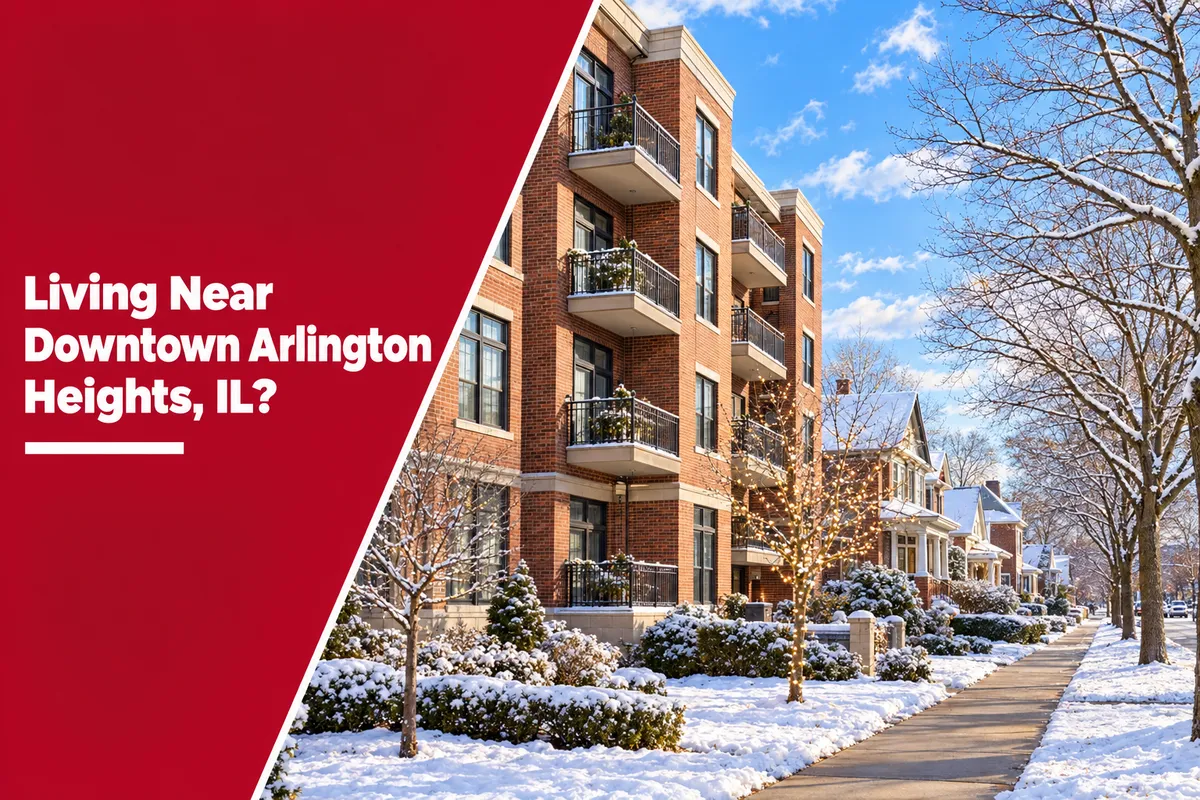
Is Living Near Downtown Arlington Heights, IL Worth It in Winter?
Living near downtown Arlington Heights is worth it in winter if you'll actually use what's there, and this year there's more to use: the village and park district are putting a 40-by-80-foot ice rink called Skate on Eastman on Eastman Street, tentatively running from late November to mid-February. The trade-off is that winter near a busy downtown means a closed street, tighter parking and snow you'll share with a lot of neighbors, so the right home type matters more than the rink does.
A buyer coming out of a Chicago apartment put it to me this way a couple of weeks ago: "Everybody sells me the suburbs in July. What's downtown Arlington Heights like in January?" Fair question. So let's talk about the cold months, what the new rink adds, what's still only on paper, and which kind of home holds up best when the temperature drops.
What is Skate on Eastman, and when does it open in downtown Arlington Heights?
Skate on Eastman is a winter pilot program. The rink goes on Eastman Street between Arlington Heights Road and Evergreen Avenue, just south of North School Park, where the village holds its annual tree lighting, according to the Daily Herald's October 20 report. It's mechanically chilled and sits on a leveling platform because the roadway curves.
The dates come with a weather asterisk. The Daily Herald reported the rink is tentatively scheduled for November 28 through February 15, with the goal of having it ready for the November 27 tree-lighting ceremony. Patch reported a target completion of November 15, and Village Manager Randall Recklaus said sustained temperatures around 30 degrees are needed at first to freeze the ice. After that, the chiller can hold ice in weather below 50 degrees. The season ends no earlier than February 15, 2027, on a date both agencies set.
Here's who does what:
- Arlington Heights Park District: builds and runs the rink, sets the rules and schedule, collects user fees, and brings in temporary restrooms.
- Village of Arlington Heights: closes the street, provides barriers, signs, lighting, electricity, water, security and snow removal around the rink, and contributes $45,000 toward the park district's costs.
- Not announced yet in either report: admission prices, hours and skate rental. Check the park district before you plan a night around it.
The village board approved the agreement on October 19, a week after the park board signed off. The Daily Herald put the park district's first-year costs at roughly $240,000, and both agencies plan to chase sponsorships and grants.
Why the village wants a "four-season" downtown Arlington Heights.
Recklaus called the rink a focal point for the north side of downtown and said the village wants to be a "four-season downtown," drawing people to more parts of town at more times of year. Downtown Arlington Heights already has a strong summer and a strong commute. Winter is the season it's trying to win.
The base is already there. The Arlington Heights Metra station at 45 W. Northwest Highway sits on the Union Pacific Northwest line, 22.9 miles from Ogilvie Transportation Center, and in 2018 it averaged 2,506 weekday boardings, fifth-busiest of Metra's non-downtown stations, per its public station record. The Metropolis Performing Arts Centre, a 350-seat theater that opened downtown in 1999, gives the area something to do on a February night besides dinner, and the village's public record notes a recent run of new condos, restaurants and businesses in the central business district.
The village is also watching its own budget while it does this. Its proposed 2027 budget of $238.9 million holds the village's property tax levy flat, Patch reported on October 30. That's one taxing body out of several on your bill, and your assessment still drives your share, so a flat village levy doesn't promise a flat bill.
What winter actually looks like when you live near downtown Arlington Heights.
I like this downtown, and I'd still tell any buyer to look at it with January eyes. Three things change when the patios close.
The street grid changes. During the rink season, Eastman Street closes between Evergreen and Arlington Heights Road, and so does the north entrance to the adjacent parking garage, per Patch. If you're looking at a building on or near Eastman, ask how residents and guests get in and out while the rink is up, and where deliveries stop.
Snow becomes a shared problem. In a single-family home, you shovel your own walk and decide when the driveway gets cleared. In a condo or townhome association, the board's snow contract decides, and you pay for it in the monthly fee. Know which one you're buying, and read what the association's contract actually covers: drives, walks, stoops, or just the main lot.
Distances feel longer. A seven-minute walk to the train in June feels very different at 6:40 a.m. with wind off Northwest Highway. Buyers who plan to commute daily should do that walk in the cold before they write an offer. The same goes for the walk to the rink with a pair of skates and a thermos.
Condo, townhome or house: which works best near downtown Arlington Heights in winter?
This is the question that actually decides whether downtown living works for you. Arlington Heights grew fast after World War II; the village reached 64,884 people by 1970, when nearly all available land was developed, per its public record. So the blocks around downtown mix older single-family homes with the newer condo and apartment buildings closer to the tracks. Each one has a different winter.
- Elevator condo near the station: heated garage parking, no shoveling, and the shortest walk to the train and the rink. The cost is the monthly assessment, and the risk is a building that hasn't saved enough for roofs, elevators and garages. Ask for the budget, the reserve study if one exists, and any special assessments in the last few years.
- Townhome: more space and often an attached garage, with exterior snow handled by the association. Check whether the fee covers your driveway and front walk or only the shared drives.
- Older single-family home a few blocks out: the most control and usually the most space, but you own the furnace, the roof, the gutters and the sidewalk. On a house from the 1950s or 1960s, I want the inspector spending real time on the heating system, the attic insulation and how water leaves the lot when snow melts.
Ryan's take: If someone in your house commutes on the UP-NW every day, buy the condo or townhome you can walk to the platform from, and put your money into a well-funded association instead of a bigger yard. If nobody commutes, buy the house a few blocks out and treat the rink and downtown as a short drive, not a reason to pay for proximity.
What's still only planned on Eastman Street.
A pilot is a test, and the village said so. Within 60 days after the rink comes down, the village and park district will review the season and decide whether to bring it back, per Patch. The Daily Herald reported that officials may later consider a second rink so skating and hockey can run at once, which would need an electrical upgrade from 200 to 600 amps, plus a permanent pavilion roof and possibly a permanent or semi-permanent plaza. All of that is possible. None of it is decided.
Eastman Street has another project to watch. Mylo Arlington Heights, a six-story building with 135 apartments, a ground-floor restaurant and a pool deck at 116-120 W. Eastman St., was approved by the village board in December 2023, per the village's project page. It has stalled more than once. In June, the Daily Herald reported the village now requires construction to begin by the end of 2026 and that developers expected to start tearing down two vacant office buildings on the site in August. I couldn't find a public update confirming demolition has started, so treat it as planned until you see equipment on the lot. If you're buying on that block, ask your real estate agent to check the village's latest permits before you pick a price.
Hanover Park is in a similar spot around its train station, with a long-planned direction and no fixed timeline, which I covered in my breakdown of Hanover Park's draft comprehensive plan on Monday.
What Skate on Eastman means for Arlington Heights homeowners, buyers and sellers this winter.
For owners near downtown, the rink is a good-news item with no downside I can see beyond a few months of a closed street. It brings people downtown on nights that used to be quiet, and that helps the restaurants and shops that make the area worth living near. Just don't expect an appraiser to add value for it this winter; a seasonal pilot doesn't show up in comps.
Buyers get a rare chance to see the downtown at its most honest. Have your real estate agent set up at least one showing on a cold weeknight in December, not just a Saturday afternoon. Walk from the front door to the platform and to the rink. Look at how the building's lot and walks were cleared after the last snow. Compare walk-to-town homes against each other, too; Palatine just finished its own downtown makeover, and my checklist for buying near downtown Palatine covers the trains, parking and construction questions that apply here as well.
Sellers near downtown can list this winter with a real advantage: a buyer touring in December can see the lights, the rink and the busy sidewalks for themselves. Put the walking time to the station and to the rink in your listing in minutes, use photos of what exists now, and describe the rink as the seasonal pilot it is. Then price on closed sales, because the regional numbers in this month's Northwest Suburbs housing market update show more listings taking cuts than a year ago, and an overpriced listing near a nice downtown still sits. Want a number before we sit down? Start with my home valuation request; for a downtown condo, I measure it only against sales in buildings like yours.
How Arlington Heights compares with the Northwest Suburbs around it.
- Palatine: to the northwest on the same UP-NW line, with a smaller downtown that finished its Slade Street streetscape this fall.
- Mount Prospect: next stop to the east, with its own downtown and Metra station, and a good comparison for buyers who want a train town without Arlington Heights' busier core.
- Rolling Meadows: to the southwest, with many ranches and split-levels and a drive, not a walk, to the train.
- Elk Grove Village: to the south, incorporated in 1956 as a planned community, with a large business park and a short drive to O'Hare.
- Schaumburg: to the southwest, bigger shopping and dining hubs and a car-oriented layout instead of a walkable train-town center.
Frequently Asked Questions
1. When does Skate on Eastman open in Arlington Heights, IL?
It's tentatively scheduled for November 28, 2026, through February 15, 2027, but the opening depends on sustained temperatures around 30 degrees to freeze the ice.
2. Where is the new ice rink in downtown Arlington Heights?
On Eastman Street between Arlington Heights Road and Evergreen Avenue, just south of North School Park, which closes that block for the season.
3. How far is Arlington Heights from Chicago on Metra?
The Arlington Heights station is 22.9 miles from Ogilvie Transportation Center on the Union Pacific Northwest line; check Metra's current schedule for travel times.
4. Is a condo or a house better near a suburban downtown in winter?
A condo or townhome usually wins for daily train commuters who want no shoveling, while a single-family home a few blocks out suits buyers who drive and want space and control.
5. What school districts serve Arlington Heights, IL?
Most of the village is in Arlington Heights School District 25 and Township High School District 214, with some areas in Districts 15, 21, 23, 59 and 211, so confirm the districts for any specific address.
Final Thoughts
Downtown Arlington Heights already works in summer and on weekday mornings at the train. Skate on Eastman is the village's bet that it can work in January, too, and for owners on the nearby blocks, the biggest cost of the first season is a closed street. Whether living near it is worth it comes down to how you'll use it and which kind of home you choose. Pick the home type that fits your winter, verify anything that's only planned, and price or offer off real sales.
Arlington Heights is a short drive from my Schaumburg office, and I work with buyers and sellers across this part of the Northwest Suburbs as Ryan Saoudi, a solo Realtor® with eXp Realty. No teams. No hand-offs. Just me. If you're weighing a condo by the station against a house a few blocks out, or wondering how to time a winter listing near downtown, call Ryan Saoudi, Realtor®, at 773-389-4193 and we'll go through the actual numbers on the homes you're looking at.